
New Report Finds Firms with Connected Data Realizing Greater Value from AI and Technology Investments
New research from Elite and Law.com reveals firms seeing the strongest operational and profitability outcomes share one common advantage: real-time, connected financial data
NEW YORK, NY, June 2, 2026 — A new Law.com report conducted with Elite reveals a growing divide between the law firms investing in technology and those successfully turning that investment into measurable impact.
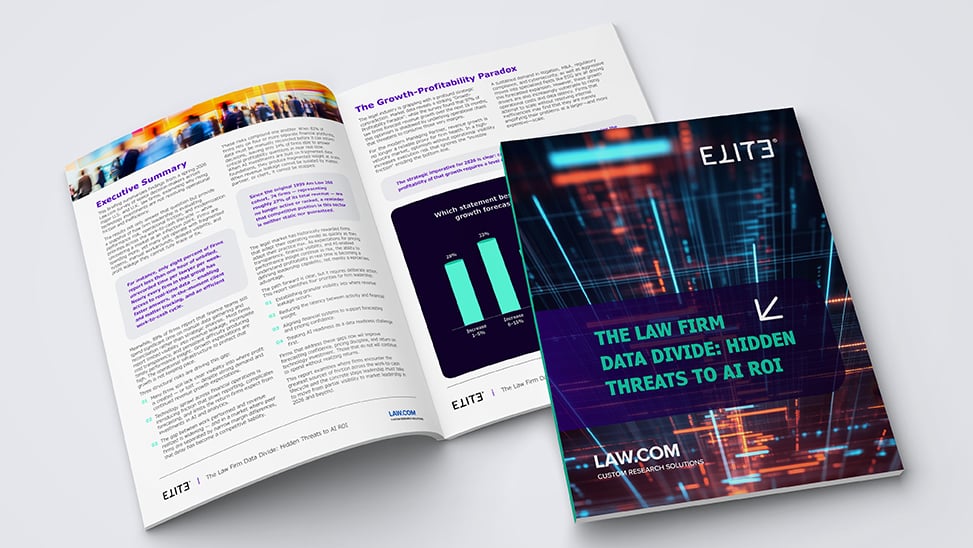
The Law Firm Data Divide report based on responses from more than 130 senior law firm decision-makers across the United States and United Kingdom, found that while technology and AI investment across the legal industry continues to grow, only a small group are consistently realizing measurable returns in operational speed, financial visibility, and revenue performance. Of that minority, nearly all share one common characteristic—access to connected, real-time financial data.
Connected Data Emerges as the Key Differentiator
The research identified a small group of operational leaders emerging across the market. Just 8% of firms reported losing less than one unbilled hour per lawyer per week—and nearly 90% of firms in that group said they have access to real-time financial data.
These firms were also significantly more likely to answer profitability questions quickly, track client and matter performance in the moment, and operate more efficient work-to-cash processes—suggesting the firms generating the strongest operational and financial outcomes are those with unified systems and connected data environments.
By contrast, most firms remain constrained by fragmented systems, disconnected financial data, and manual reconciliation processes that limit visibility into profitability and slow decision-making across the business.
Revenue Leakage and Operational Friction Continue to Grow
More than two-thirds of firms (67%) said they’re losing between one and three billable hours per attorney per week, while another 25% estimated losing four hours or more.
For a 500-attorney firm, that can equate to as many as 67,200 lost billable hours annually, representing more than $30 million in potential billable value based on standard rates for large firms. For firms with 1,000 attorneys or more, that exposure can exceed 134,000 hours annually.
Despite this, only 38% of firms said they have full visibility into where revenue leakage is occurring across partners, practices, matters, or clients.
AI Investment Outpacing Operational Readiness
The findings suggest many firms are accelerating AI investment before addressing the operational and data fragmentation limiting its effectiveness.
Nearly half of respondents (47%) cited lack of integration between systems as the biggest barrier preventing them from fully leveraging AI, with the same percentage revealing finance teams spend more than a quarter of their time manually gathering, reconciling, and reporting on disconnected data.
When asked where “invisible friction” most impacts financial operations, respondents pointed to:
-
Data extraction and reconciliation across systems (56%)
-
Forecasting and budgeting (55%)
-
Understanding true profitability (54%)
As a result, only 39% of firms said they clearly understand their true cost to deliver legal services, with most relying on partial estimates or firm-wide averages rather than real-time operational insight.
“Law firms are investing heavily in AI and modernization, but this research highlights a growing gap between firms experimenting with AI and those creating measurable business value from it,” said Mark Dorman, CEO, Elite. “AI is only as effective as the quality, accuracy, and timeliness of the data informing it. The firms pulling ahead are reducing fragmentation across their systems, connecting real-time financial data across the business, and building the foundation needed to turn AI into real value.”
Across the legal industry, firms will continue to reach the same conclusion—connected, real-time financial data is critical to improving operational visibility, reducing work-to-cash friction, and getting meaningful value from AI investments.
Elite is addressing this challenge with Data Connect, which unifies firm financial and operational data to provide near real-time business insight. The solution helps firms reduce operational friction, improve visibility, and build the connected data foundation needed for AI and modern law firm operations.
+++
About the Research
The survey was conducted for Elite by Law.com in March 2026 and included responses from 133 senior law firm decision-makers, including partners and C-suite leaders, primarily from large and mid-sized firms in the United States and United Kingdom.
About Elite
Elite is the AI platform for law firm operations across the world’s largest and most successful law firms. Founded in 1947, Elite has guided firms through every technology shift and today delivers the only AI-enabled SaaS platform that unifies financial, invoice, time, and data management into a single system of action. Learn more at elite.com.
Elite® is a registered trademark of Elite; all other trademarks are property of their respective owners.
