Stop Invoice Rejections Before They Happen
See how firms are battling client-side AI that has caused a 64% increase in rejection rates using eBillingHub and Elite Validate.

Our research across nearly 400 law firms pinpointed exactly where realization slips between invoice and collection. See what the data revealed — and how leading firms are reversing rejections.

Across nearly 400 law firms, rejection rates climbed as client-side AI began enforcing guidelines with a speed and subjectivity no rules engine was built to anticipate. Most e-billing tools were designed for a world where compliance was static. That world is gone.
What the Data Proves You Need
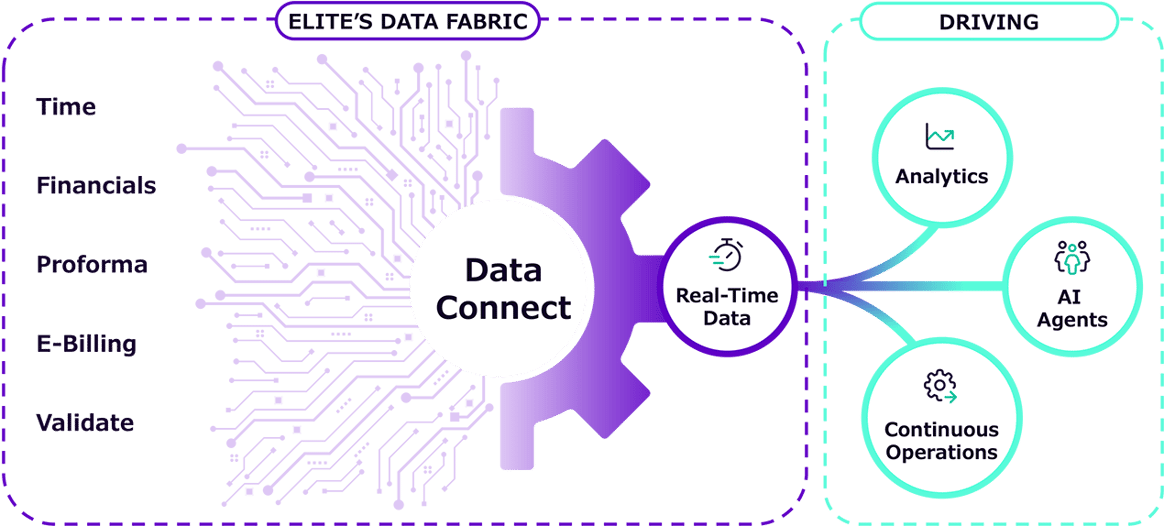
Firms with real-time visibility into their financial data don't just report on leakage — they stop it. Data Connect delivers governed, near real-time 3E data directly into Microsoft Fabric. Less assembling.
Nearly 50% of firms say lack of integration is the biggest barrier to AI ROI. Data Connect removes that barrier, so every agent, Copilot, and automation workflow runs on data it can trust.
Most firms run financial operations across 4 or more systems. Data Connect puts 3E financial data inside Fabric alongside CRM, HR, billing, and operational data — so every team is working from the same numbers
With governed 3E data continuously available in Fabric, leadership can answer questions about profitability, leakage, staffing, and collections as work happens — not days later. When data is current, leakage patterns surface before they become write-offs.
Data Connect manages infrastructure, security, governance, and updates — delivering near real-time 3E data without custom engineering or ongoing maintenance overhead.
AI doesn't fail because of the model. It fails because of the data. Every agent or automated workflow your firm deploys needs clean, unified, governed data to function reliably. Data Connect is that foundation, and it’s already working inside Fabric.

The most important questions your firm needs to answer aren't in any dashboard. When determining where to invest and what drives growth, you need near real-time data to make the judgement call. With Data Connect, those questions finally have answers. That's the difference between reporting on what happened and deciding what to do next. Firms that answer those questions in real time recover revenue that fragmented systems let slip.

Finance teams spend too much time on manual data gathering and report prep instead of strategic analysis. Data Connect eliminates that by delivering clean, governed 3E data automatically so your team can focus on what actually moves the firm forward.


Firms on 3E Cloud have access to their data — the challenge is getting it into analytics, reporting, and AI tools without rebuilding pipelines or consolidating into another system. Data Connect provides that delivery, directly into Microsoft Fabric, continuously and securely.
Once 3E data is inside Fabric, your teams can use it across reporting, workflows, automation, and AI without being limited by vendor architecture or asking anyone for permission.
A unified, governed data layer isn't just useful for reporting — it’s what makes automation, AI, and real-time decision-making possible. With 3E data flowing continuously into Fabric, firms can automate end-to-end processes, deploy agentic AI, and scale without rebuilding the infrastructure underneath it.
See how firms are battling client-side AI that has caused a 64% increase in rejection rates using eBillingHub and Elite Validate.

Payments are arriving faster, but invoice rejection rates are climbing. Learn what the latest e-billing data means for law firm revenue cycles.

Walk through your firm’s rejection rate and cycle time with an Elite expert.
Most rejections come from invoices that don't match a client's outside counsel guidelines or the formatting rules of their e-billing system — wrong task or activity codes, missing detail, or rate and staffing violations. Validating each invoice against those rules before submission catches the errors that cause rejections, resubmissions, and the write-offs that follow. Elite Validate runs those checks automatically inside eBillingHub.
The work-to-cash cycle is the full journey from work performed to cash collected — capturing time, generating and validating invoices, delivering them, and following up until payment lands. Firms lose the most time and revenue at the points where invoices get rejected, reduced, or stalled in collections. Shortening the cycle means tightening each of those handoffs.
OCG violations usually slip through because guidelines are complex, client-specific, and checked manually late in the billing process. Validating invoices against each client's OCGs before submission — rather than catching issues after a rejection — is the most reliable way to reduce them. This kind of pre-submission compliance check is what Elite Validate automates.
Fee reductions happen when clients or their review systems flag line items that don't comply with billing guidelines, then deduct or appeal them — quietly eroding realization invoice by invoice. Consistent compliance up front protects margin that would otherwise be written off after the fact. Enforcing those rules before invoices go out is more effective than disputing reductions later.
DSO shrinks when invoices go out faster, reach clients in the right format the first time, and are followed up on consistently rather than manually. Automating delivery, reminders, and reconciliation removes the delays that stretch the time between invoice sent and payment received. Firms using integrated billing and collections tools typically see steadier, more predictable cash flow.
E-billing is the electronic submission of legal invoices to clients through their billing or matter-management systems, governed by each client's formatting rules and outside counsel guidelines. Because every client's system and rules differ, firms use a central hub to submit, track, and manage invoices across vendors. Elite's eBillingHub consolidates that process in one place.
It's worth evaluating when rejection rates are climbing, collections are slow, or billing staff are spending more time on manual rework than client-facing work. Rising client scrutiny — including AI-assisted invoice review — is making pre-submission compliance more important than it used to be. A buyer's checklist that scores tools on validation, delivery, payments, and collections is a practical starting point.